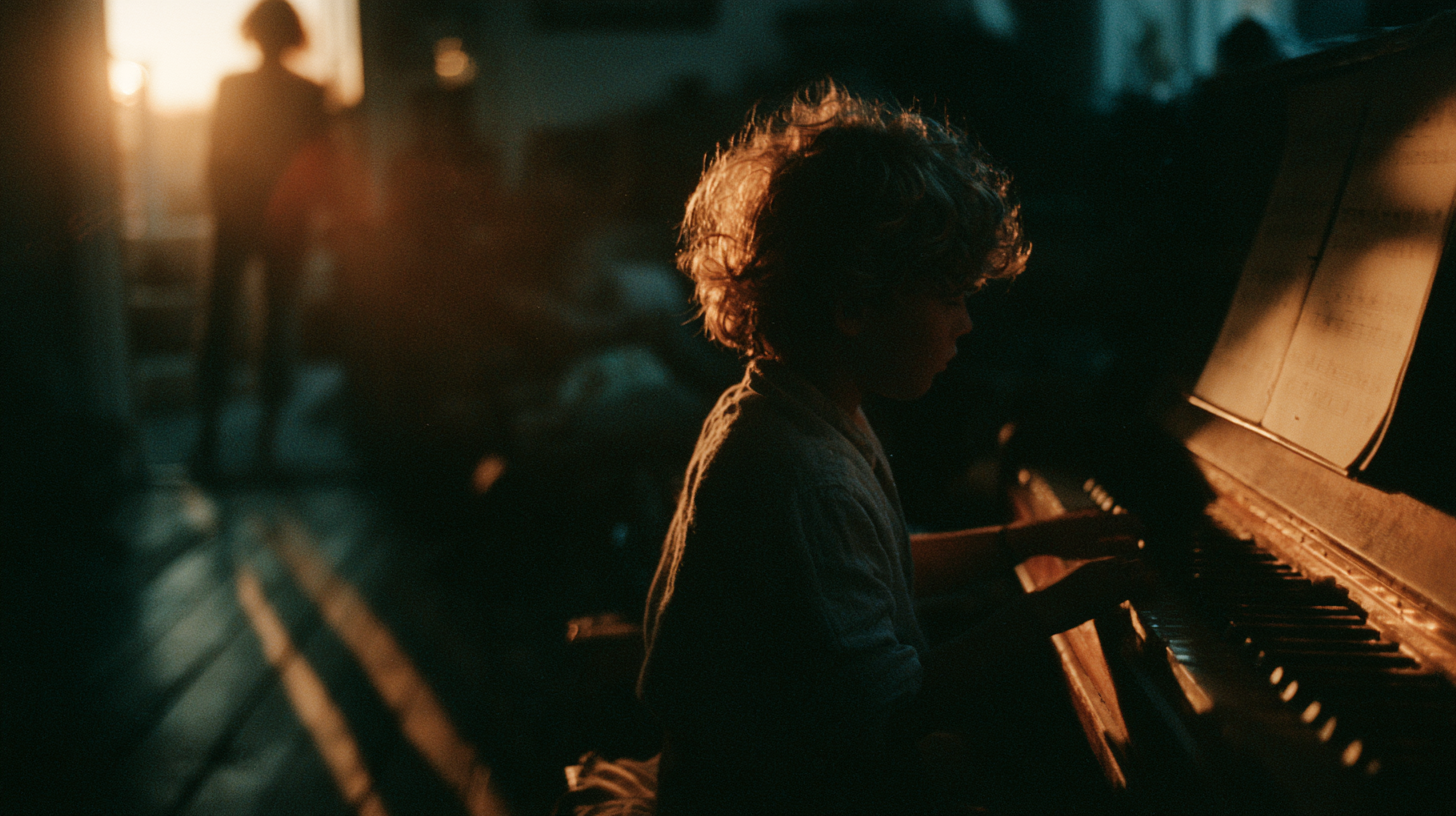
It is 4:47 on a Tuesday afternoon. The parent is in the kitchen. The child is in the next room, at the piano. The practice book is open. The metronome is silent. Nothing has happened yet, and both of them know exactly what is about to happen.
The parent has been at work all day. The child has been at school all day. There is one hour before dinner needs to be made, before homework gets checked, before the bath, before bed. That hour is supposed to contain piano practice. It will instead contain a fight.
The script is so familiar that both parties already know their lines. The parent will ask once, gently. The child will say in a minute. The parent will ask again, less gently. The child will play one wrong scale and stop. The parent will sit down on the bench. The child will tense up. The parent will say something corrective. The child will cry, or shout, or go quiet. The parent will end the practice early, or push through it, and then spend the rest of the evening wondering whether to keep paying for the lessons.
This has been happening for months. The Google search history on the parent's phone is a record of escalating panic. How to motivate child to practice piano. Child refuses to practice piano. Child hates piano practice. Piano practice rewards chart. Daily piano practice struggle. How to make my child practice without fighting. This article is the answer none of those searches will surface.
Why does my child hate piano practice?
The fight is not a discipline problem. The fight is not a motivation problem. The fight is not a sign that the child lacks grit, or that the parent lacks patience, or that the teacher lacks rapport. The fight is a structural artifact of an instructional model that asks the wrong person to do the most important job.
The clearest single piece of evidence comes from a study conducted at the University of Ottawa's piano pedagogy research lab. Karen Gerelus, Gilles Comeau, and Mikael Swirp compared 55 piano students who had quit lessons against 153 students who continued1. Both groups had taken lessons for similar lengths of time. Both groups came from similar families. The researchers expected to find that parents of dropouts were less involved, less attentive, less present at lessons and at the piano bench. They found the opposite. The rate at which parents attended lessons, contacted the teacher, or helped with home practice was statistically indistinguishable between the two groups. The averages actually suggested that parents of dropouts helped slightly more with home practice than the parents whose children kept playing.
The most quoted sentence in the study was not written by the researchers. It was written by one of the parents of a child who quit. Asked to name the main reason for stopping lessons, the parent wrote three words.
Practising was a fight.
Parent of a piano dropout, quoted in the largest peer-reviewed dropout-comparison studyA follow-up study by the same team in 2020 took the data and pushed harder2. The team framed the question through Self-Determination Theory and asked whether the type of parental involvement, not just the amount, was predicting outcomes. The finding was sharper than the first paper. Parents sitting in lessons was negatively correlated with the child's autonomous motivation. There was no relationship between practice time and motivation at all. The dropout students were not lazy. They had run out of the kind of motivation that survives without external pressure, and external pressure was exactly what they had been given.
Gerelus, Comeau, Swirp & Huta (2020) compared parents-sit-in-lessons, parents-help-with-practice, and rewards-for-piano-achievements between 55 dropouts and 260 continuing students framed within Self-Determination Theory. The finding the field has been slow to absorb: parental presence in lessons was negatively correlated with autonomous motivation. Practice time, taken alone, predicted nothing. The level of autonomous motivation in the dropout group was insufficient to sustain further study, regardless of how many minutes per week were logged.
Bulletin of the Council for Research in Music Education, No. 225This is why the fight does not respond to your tactics. The fight is the predictable output of asking an untrained parent to play a trained role in a high-stakes daily encounter. You can change the timer. You can change the reward. You can change the time of day. You will be solving for variables that are not the variable.
The same pattern shows up inside the lesson room. In a 2005 study in the Journal of Research in Music Education, Eugenia Costa-Giomi, Patricia Flowers, and Wakaha Sasaki compared fourteen matched pairs of first-year piano students3. Each pair shared a teacher. Each pair was matched on initial ability. One child in each pair would persist for three years. The other would drop out. The future dropouts elicited verbal cues from the teacher more often. They sought approval more often. They received fewer actual approvals. They accomplished fewer of the goals the teacher set for them inside the lesson.
The dropouts were not lazier than their peers. They were arriving at the lesson behind. Not because their teacher was different. Their teacher was the same teacher. Not because their ability was different. Their ability had been matched. They were arriving behind because the six days between lessons had not gone well, and the weekly format could not detect or correct the drift fast enough to compensate. The teacher tried to catch up inside thirty minutes. The student tried to stay afloat. The parent in the kitchen had spent the week doing their best. None of these people were the problem. The structure they were arranged inside was the problem.
What is the parent actually being asked to do?
Open a manila folder labeled "Parent Job Description" and look at what the weekly-lesson model has quietly placed inside it. The roles are not optional. They are necessary if the structure is going to function.
Decides when practice happens, enforces the start time, defends the time from competing obligations, restarts the routine after vacations, illnesses, and missed days.
Sustains the child's interest across six days of unsupervised practice between lessons, on the strength of whatever fragmentary feedback the parent retained from the teacher's twenty minutes of attention the previous Saturday.
When the child resists, the parent enforces. The parent decides whether resistance gets met with patience or pressure or capitulation, and then bears the relational cost of whichever decision they made.
Without sheet-music literacy, without ear training, without pedagogical training, the parent listens to the child play through the assigned piece and tries to determine whether what they just heard was correct, wrong-but-improving, or wrong-and-consolidating.
The teacher's notes from the lesson are the parent's only map for the week. The parent must translate them into actionable corrections in real time, with no training in pedagogy and no calibration of when to push versus when to stop.
A 2002 experiment by Wendy Grolnick and colleagues at Clark University made the structural pressure visible inside the laboratory4. Mothers were assigned to one of two conditions. In one, the experimenter told the mother that her child's task performance would be evaluated by the research team. In the other, no evaluation framing was given. The mothers in the evaluation condition became measurably more controlling and directive during the joint task. Their children subsequently performed worse on independent tasks afterward. The mothers did not change their personalities. They responded predictably to the structural framing of evaluation.
Every piano practice in your home contains the same structural framing. The lesson is on Saturday. What you do tonight will be evaluated on Saturday. The pressure does not need to be conscious to be present. Once the pressure is present, the controlling behavior follows. Once the controlling behavior is present, the autonomous motivation of the child collapses. Once the autonomous motivation collapses, the fight begins.
The deeper layer of this comes from forty years of work by Wendy Grolnick, Richard Ryan, Edward Deci, and the self-determination tradition. Mireille Joussemet, Renée Landry, and Richard Koestner formalized what autonomy-supportive parenting actually is in a 2008 paper that has become the operational reference point5. Autonomy support has four ingredients: providing rationale for requests, acknowledging the child's feelings and perspective, offering choices and encouraging initiative, and minimizing controlling techniques. The list is short and useful. It is also nearly impossible to execute while you are simultaneously functioning as the substitute instructor, the disciplinarian, and the feedback giver, because those roles structurally pull in the opposite direction. Autonomy support requires time, calm, and freedom from being the person responsible for the outcome. The weekly-lesson model strips all three from the parent's evening.
The average impact of tangible, expected, engagement-contingent rewards on free-choice intrinsic motivation across 128 controlled experiments. The undermining effect is more pronounced in children than in adults. The sticker chart on your refrigerator has a measured effect size in the wrong direction.
Do piano practice rewards charts actually work?
The popular advice column treats sticker charts, reward systems, and expected tangible incentives for completing practice as the friendly alternative to nagging. The research literature treats them as something else entirely.
In 1973, Mark Lepper, David Greene, and Richard Nisbett ran what would become one of the most replicated experiments in developmental psychology. The site was the Bing Nursery School at Stanford6. Fifty-one preschoolers who already showed intrinsic interest in drawing were assigned to one of three conditions. In the first, children were promised a "Good Player Award" certificate if they would draw with new markers. In the second, children received the same award unexpectedly after drawing. In the third, no award was offered and none was given. Two weeks later, the researchers observed free-play time. Children in the expected-reward condition spent roughly half as much free-choice time drawing as children in the other two conditions. The promised reward had taught the children, in two weeks, that drawing was something one did for the reward.
Twenty-six years later, Edward Deci, Richard Koestner, and Richard Ryan synthesized 128 experiments in the most comprehensive meta-analysis of the overjustification literature ever attempted7. Tangible, expected, engagement-contingent rewards undermined free-choice intrinsic motivation by an average effect size of d = −0.40. Completion-contingent rewards: d = −0.36. Performance-contingent rewards: d = −0.28. The effect was more pronounced for children than for college students. Positive verbal feedback, by contrast, enhanced intrinsic motivation by an effect size of d = 0.33.
The sticker chart on your refrigerator is not a neutral tool. It is an intervention with a measured effect size in the wrong direction. The child who used to want to play the piano is being trained, sticker by sticker, to play it for the sticker. When the stickers stop, so does the playing. This is not your fault. You were never told. The commercial layer that sells you the chart did not tell you. The teacher who suggested it almost certainly did not know the literature either. The blog post that ranked first on Google when you searched did not cite a single study. You were doing the recommended thing.
Should I sit with my child while they practice piano?
This is the highest-leverage question in the practice-fight literature, because both the dominant SEO answer (yes) and the contrarian backlash (no) miss what the research actually says. The honest answer is conditional. Parental presence at practice can help. It can also do harm. The variable that determines which one happens is whether the parent has been trained for the role.
The strongest counter-evidence to a flat "no, do not sit with them" recommendation comes from Jane Davidson and her colleagues at Keele. In their 1996 study of 257 children across the full range of musical achievement, the most successful young musicians had parents who were highly involved in lessons and practice8. A separate sample of 42 students at a UK specialist music school showed that only three of those 42 students had parents not involved in practice sessions, and roughly a third of the parents provided active moment-by-moment supervision9. At first glance, this contradicts the article you are reading.
The reconciliation is in the demographic detail. The parents in the high-achiever subsets were disproportionately musicians themselves, or had taken explicit roles modeled on the Suzuki method, which formally trains parents as co-instructors. The exception proves the structural claim. Parent-led practice can work when the parent has been trained for the job. The problem is parental presence in the absence of training, in the absence of compensation, in the absence of role clarity, and in the presence of a weekly-feedback structure that requires someone to fill the six-day gap.
Sloboda & Howe (1991); Davidson, Howe, Moore & Sloboda (1996)Gary McPherson at the University of Melbourne synthesized this literature in a 2009 review10. The pattern across the studies was unambiguous. The most successful learners had parents who provided high involvement in the earliest stages of learning that tapered as the child developed autonomy. The children who gave up came from homes where parents either disengaged entirely or, more commonly, applied increasing pressure precisely when the child's autonomous motivation was already collapsing. Andrea Creech's 2010 paper in the same journal proposed a three-factor model11. Behavioural support, cognitive support, and personal support all map to productive parental involvement. Instructional authority, in her framework, is partitioned to the teacher. The parent is not the substitute instructor. The parent is the structural enabler.
The honest answer to the question is therefore not yes or no. It is conditional. If you have formal training in the instrument and the patience of a saint and the relational architecture to switch between teacher and parent without confusion, sitting with your child can help. If you do not have all three, sitting with your child is likely to produce the fight that brought you here.
How do I get my child to practice piano without fighting?
The Six-Day Drift, which I describe at length elsewhere in this series, is the mechanical reason the weekly model places the parent inside the practice room. A teacher who sees the child for twenty or thirty minutes once a week is present for roughly fifteen percent of the child's piano time. The other eighty-five percent is unsupervised. The parent is in the practice room because someone has to be. This is the right place to ask what would happen if no one had to be.
K. Anders Ericsson's 1993 paper on the role of deliberate practice in the acquisition of expert performance is the most-cited single piece of writing on skill development in the past forty years12. Ericsson, Ralf Krampe, and Clemens Tesch-Römer defined deliberate practice as effortful activity with explicit goals, immediate informative feedback, and opportunities for repetition with revision. In the language of the paper itself, effective learning requires "explicit instructions about the best method" and supervision by "a teacher to allow individualized diagnosis of errors, informative feedback, and remedial part training."
Practice between weekly lessons does not meet this definition. There is no immediate informative feedback. There is no individualized diagnosis of errors. There is the parent listening from the kitchen, hoping the wrong note they heard was not what they thought it was, and the child sliding into a fingering pattern that will need to be unlearned next Saturday. This is not deliberate practice in Ericsson's sense. It is something closer to rehearsal of error.
What would resolve the fight is not better tactics. What would resolve the fight is the elimination of the structural condition that produces it. If the child receives corrective feedback every day from a trained instructor, the parent is no longer the substitute teacher. The parent becomes what the research literature has consistently identified as the productive parental role in musical development: the logistical and emotional supporter, the person who makes the practice possible without being inside the practice itself.
Habit research adds the final layer. Phillippa Lally's 2010 study at University College London tracked 96 volunteers as they tried to form new daily behaviors13. The asymptotic time to automaticity ranged from 18 to 254 days, with a median of 66. The active ingredient was not motivation. It was repetition of a behavior in a consistent context. Wendy Wood's work on context-cued habits confirms the same point at the cognitive level14. Disrupted context kills habits, even when motivation is intact. A practice routine that depends on the parent's daily emotional energy is structurally fragile. A practice routine that is anchored to a daily appointment with a person whose job it is to show up is structurally durable.
The path out of the fight is to stop solving for the fight and start solving for the structure that produces it.
The Question Behind the Question
The search query that brought most readers to this article contains an unexamined assumption. The assumption is that getting your child to practice is your job. The question is how to do that job better. The article you have just read has spent four thousand words showing that the assumption is the problem. When the parent is the daily feedback layer, the daily motivator, the daily disciplinarian, and the daily evaluator, the conflict is not a failure of execution. The conflict is what the structure produces. There is no version of these five jobs, performed every evening, by an untrained adult, in the room they share with the person they love most, that does not produce a fight.
The real question is not how to fight better. The real question is whether the job description was ever yours to begin with. Children who want to quit piano are, in many cases, not quitting piano. They are quitting the daily fight. They cannot see, from inside the practice room, that the fight is not the piano. You can. The next decision is not a tactical one. It is a structural one. You can keep the weekly-lesson model and accept that the fight is the cost of the structure. You can stop the lessons and accept that the child will not learn the instrument. Or you can change the structure.
"The fight is not a parenting failure. It is the predictable output of asking an untrained adult to do a trained job, every evening, in the room they share with the person they love most."
What if your child could receive corrective feedback every day, from someone whose job it is to be there?
The research says outcomes depend on feedback frequency, habit installation in the first 24 months, and who carries the daily follow-through. Oclef's daily-lesson model was built around exactly these variables. We serve hundreds of students with a 91% success rate because we redesigned the unit of analysis from the weekly lesson to the daily week. The parent stops being the substitute instructor. The fight stops being the cost of the lessons.
Not ready yet? Save this article. Send it to a parent you know who is having the same fight tonight. They are searching for a sticker chart. Now you know what the research actually measures.
Selected Research References
- ComparativeGerelus, K., Comeau, G. & Swirp, M. (2017). Predictors of Piano Student Dropouts. Intersections: Canadian Journal of Music, 37(2), 27–46.
- ComparativeGerelus, K., Comeau, G., Swirp, M. & Huta, V. (2020). Parting Ways With Piano Lessons: Comparing Motivation Between Continuing and Dropout Piano Students. Bulletin of the Council for Research in Music Education, No. 225, 45–66.
- LongitudinalCosta-Giomi, E., Flowers, P.J. & Sasaki, W. (2005). Piano lessons of beginning students who persist or drop out. Journal of Research in Music Education, 53(3), 234–247.
- ExperimentGrolnick, W.S., Gurland, S.T., DeCourcey, W. & Jacob, K. (2002). Antecedents and consequences of mothers' autonomy support: An experimental investigation. Developmental Psychology, 38(2), 143–155.
- ReviewJoussemet, M., Landry, R. & Koestner, R. (2008). A self-determination theory perspective on parenting. Canadian Psychology, 49(3), 194–200.
- ExperimentLepper, M.R., Greene, D. & Nisbett, R.E. (1973). Undermining children's intrinsic interest with extrinsic reward: A test of the "overjustification" hypothesis. Journal of Personality and Social Psychology, 28(1), 129–137.
- Deci, E.L., Koestner, R. & Ryan, R.M. (1999). A meta-analytic review of experiments examining the effects of extrinsic rewards on intrinsic motivation. Psychological Bulletin, 125(6), 627–668.
- LongitudinalDavidson, J.W., Howe, M.J.A., Moore, D.G. & Sloboda, J.A. (1996). The role of parental influences in the development of musical performance. British Journal of Developmental Psychology, 14, 399–412.
- InterviewSloboda, J.A. & Howe, M.J.A. (1991). Biographical precursors of musical excellence: An interview study. Psychology of Music, 19(1), 3–21.
- ReviewMcPherson, G.E. (2009). The role of parents in children's musical development. Psychology of Music, 37(1), 91–110.
- ReviewCreech, A. (2010). Learning a musical instrument: The case for parental support. Music Education Research, 12(1), 13–32.
- FoundationalEricsson, K.A., Krampe, R.T. & Tesch-Römer, C. (1993). The role of deliberate practice in the acquisition of expert performance. Psychological Review, 100(3), 363–406.
- LongitudinalLally, P., van Jaarsveld, C.H.M., Potts, H.W.W. & Wardle, J. (2010). How are habits formed: Modelling habit formation in the real world. European Journal of Social Psychology, 40(6), 998–1009.
- ReviewWood, W. & Neal, D.T. (2007). A new look at habits and the habit-goal interface. Psychological Review, 114(4), 843–863.